Welcome to the Mathematical World!
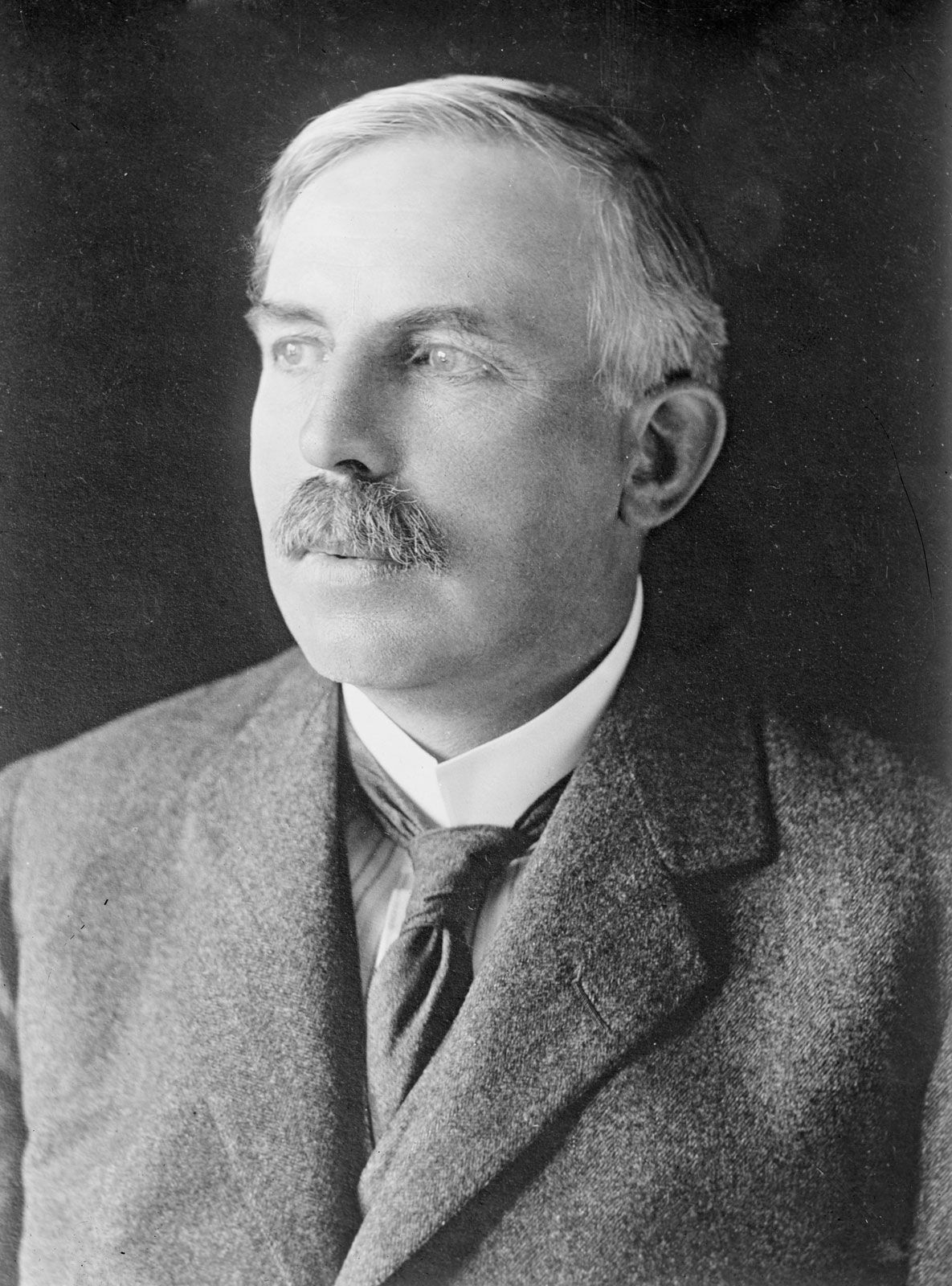
Ernest Rutherford
Father of Nuclear Physics
Ernest Rutherford (1871–1937) was a New Zealand-born physicist whose groundbreaking work on radioactivity and the structure of the atom earned him the title “Father of Nuclear Physics.” Born in Brightwater, New Zealand, Rutherford demonstrated early scientific talent and pursued higher education at the University of New Zealand and later at Cambridge University under J.J. Thomson.
Research on Radioactivity
Rutherford conducted pioneering research on radioactive substances, identifying and naming alpha and beta radiation. He also discovered that radioactive decay transforms one element into another, effectively being the first to observe nuclear transmutation. His work led to the formulation of the half-life concept, describing the time it takes for half of a radioactive substance to decay:
\[ N(t) = N_0 e^{-\lambda t} \]Where \( N(t) \) is the number of undecayed nuclei at time \( t \), \( N_0 \) is the initial number of nuclei, and \( \lambda \) is the decay constant.
Gold Foil Experiment
Rutherford’s most famous experiment, conducted with Hans Geiger and Ernest Marsden in 1909, involved firing alpha particles at a thin sheet of gold foil. The results were surprising:
- Most alpha particles passed straight through.
- A few particles were deflected at large angles.
- Some bounced almost directly back.
These observations could not be explained by the Plum Pudding Model and led Rutherford to propose a new atomic structure.
Nuclear Model of the Atom
Based on the gold foil experiment, Rutherford proposed the nuclear model of the atom:
- The atom consists mostly of empty space.
- All positive charge and most of the mass are concentrated in a tiny, dense nucleus.
- Electrons orbit the nucleus, similar to planets around the Sun.
The nuclear model can be expressed schematically in LaTeX as:
\[ \text{Atom} = \text{Nucleus (positive, dense)} + \sum_i e^-_i \text{(electrons orbiting)} \]Discovery of the Proton
In 1917, Rutherford conducted experiments bombarding nitrogen gas with alpha particles, observing the emission of hydrogen nuclei. He concluded that the hydrogen nucleus is a fundamental particle, which he named the proton.
The reaction can be represented as:
\[ \ce{^14_7N + ^4_2He -> ^17_8O + ^1_1H} \]Legacy
Rutherford’s work laid the foundation for modern atomic and nuclear physics. His nuclear model was later refined by Niels Bohr, leading to the development of quantum mechanics. Rutherford also mentored future scientists such as James Chadwick, who discovered the neutron, and Ernest Lawrence, inventor of the cyclotron.
Rutherford received the Nobel Prize in Chemistry in 1908 for his investigations into the disintegration of elements and the chemistry of radioactive substances. He remains a towering figure in physics, whose insights fundamentally changed our understanding of matter.

All rights reserved by the Mathematical Unity
Contact: +8801400044645
Email: mathematicalhorse1453@gmail.com
Our Discord Server: Mathematical Unity [Ulus Riyadiyat]